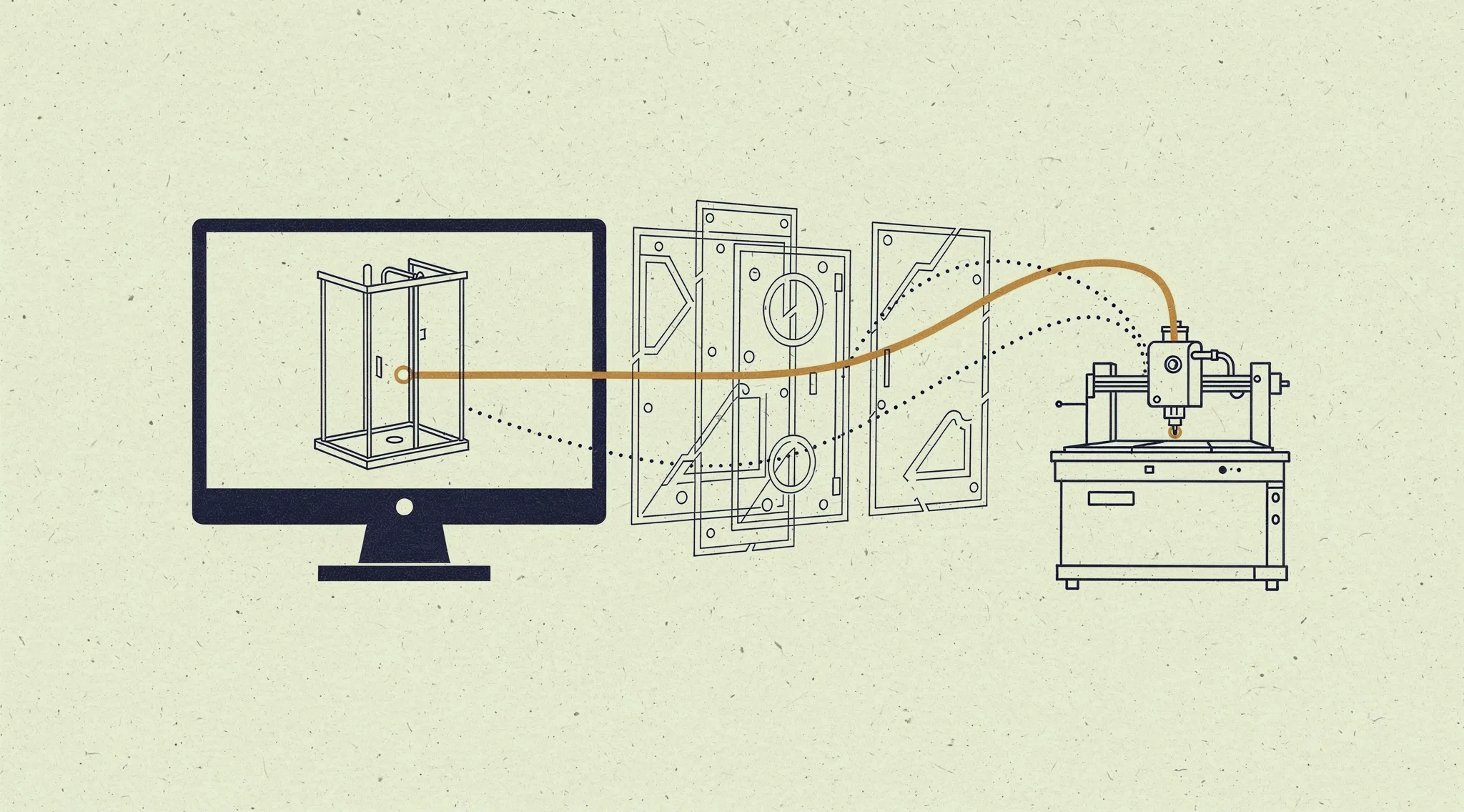
Glass does not forgive a sizing error. A wrong cut-out turns a sheet into scrap, and a handsome drawing on screen is worth nothing if the machine cannot use it.
When the foreign cloud service left the market, the manufacturer needed a tool of their own: from the site survey to a DXF file for cutting. The full estimate came to 3,393 hours. It did not fit the budget. What followed was 2 pauses, a scope cut, a change in how we worked together, and 900 bureau hours. There is still no formal sign-off, and that is part of the story.
Snapshot
| End-client sector | manufacture and installation of glass structures |
| End client | under the code-name Glass Configurator, Russia |
| Engagement | direct contract, then 2 bureau engineers inside the client’s team |
| Task | an industry product: from site survey to a drawing for the cutting machine |
| Bureau effort | 900 hours across the whole project |
| Full estimate | 3,393 hours; starting scope after the cut, 667 hours |
| First release | 69 days after the restart, into pilot use |
| Drawings verified | 2 external factories confirmed they could cut from them |
| State as of 5 August 2026 | the product is usable on the templates already loaded; some structures still show discrepancies in the drawings, and routine release into production has not begun |
The problem
The client manufactures and installs shower enclosures, partitions and other architectural glass. Between the site survey and the cutting machine sat manual work by a draughtsman in AutoCAD: allow for the gaps, place the cut-outs for hinges and handles, issue the drawing for cutting. The industry program ran only from the cloud and became unavailable on the Russian market. Installing it on their own server was not possible.
The client wanted their own equivalent. To begin with, they handed over a real order as a PDF and brought in production staff we could work through the geometry and tolerances with.
Why this is hard
The error only becomes visible at the factory: glass is cut once, and a wrong cut-out turns the sheet into scrap. A product can look excellent on screen and still emit an unusable file. So the main hypothesis had to be tested at an external plant, on their schedule and their equipment.
The second risk is budget. The full task did not fit inside it, and half an unfinished product does not deliver half the value. We had to find the part that would earn its place first, and justify the choice with an hours breakdown rather than intuition.
The third risk is people. The project stopped twice and stood still for 397 days in total. After each pause the team came back not to living memory but to the specification, the prototypes and the code it had written down earlier.
How we did it
1. Tested production first, costed the product second. The first DXF file arrived 34 days into discovery and went straight to the factory. They found a scale error: the height came out at 1000 mm instead of the size required. We fixed it in 4 minutes and had the file checked again. An early mistake cost almost nothing and confirmed the right criterion: watch the machine, not the screen.
2. Gave the full estimate and did not shade it. The estimate came to 3,393 hours and 8 to 18 months. The number was several times what the client expected, so discovery was closed as a separately paid stage. In 78 days they received a specification by module, a prototype, a drawing generator and 3 revisions of the estimate. Later it was exactly this material that let the work resume without a fresh discovery round.
3. After 397 days of standstill, cut the scope instead of the price. Almost 79% of the full estimate sat in 3 product types. For the start we kept shower enclosures and released 1,440 hours. Then stock control, the order funnel, roles, the admin panel, the calendar and the mobile version all moved to later. The starting estimate came down to 667 hours.
4. Put the drawing first, not the pricing. Managers were already costing orders in spreadsheets. The real delay came when an order had to be prepared for the shop floor: without a draughtsman in AutoCAD, a manager could not place the cut-outs and holes. The first version existed to close that gap.
5. Joined the client’s team. By the restart they had their own developer and requirements owner. The bureau supplied an analyst and a front-end developer; the analyst took technical leadership and code review across the whole team. The work ran directly: of the 2,103 messages in the working chat, 11 belonged to the bureau owner.
6. Shipped the first version after 69 days. It was incomplete, and the limitations were written down in advance. The next day the drawings went to 2 external factories. Both confirmed they could cut glass from them. The main hypothesis held up under outside checking.
What works
- A step-by-step configurator assembles the shower templates already loaded and shows the model in 3D.
- The hardware catalogue holds prices and cut-out parameters; the client fills it through the interface.
- The product issues a DXF drawing, a specification, a quotation and an installation diagram.
- There is a domain of its own, user roles, saved projects, separate environments and automated builds.
This is no longer a prototype. 2 external factories found the product’s drawings good enough to confirm the cutting. Checking drawings, though, is not the same as accepting the whole system.
What is not finished
As of 5 August 2026, routine release of orders into production has not started. According to the client’s requirements owner, the product is usable on the templates already loaded, while some structures still show discrepancies in the drawings. The business owner decided to go out on a suitable site survey himself, to walk a real order the whole way through.
The development archive ends with an overnight repair of database migrations in June 2026. There is no confirmation that the remaining defects were closed after it. So we do not call the product delivered, and we do not dress pilot use up as full production rollout.
Results
| Metric | Value |
|---|---|
| Full estimate | 3,393 hours, 8 to 18 months |
| Starting scope | 667 hours instead of 3,393 |
| Pauses before the restart | 397 days |
| To the first working version | 69 days, then pilot use |
| External verification | 2 factories confirmed the cutting from the drawings |
| Bureau effort | 900 hours across the whole project |
| Current status | templates work; routine release of orders into production and part of the drawing discrepancies are still ahead |
In 900 bureau hours the project moved from a first DXF and a 3,393-hour estimate to a working version inside the client’s team. The most valuable part has been tested: the program builds drawings, and external factories can work from them. The hardest part is still open, which is turning individual successful runs into a routine production process.
Team
- Analyst-developer from the bureau, technical leadership and code review. On the project throughout, from May 2023 to June 2026, 3 years on one product
- Front-end developer from the bureau, the configurator interface and the 3D scene
- Anton Hersun, Xaver Pro, project manager
If you are planning your own industry product to replace software that left the market, send us a description of the process it has to cover: from the site survey to the order reaching production. We will come back with an estimate in hours and a plan that starts with a working part rather than the full scope. The assessment is free.